Simplifying use of Custom Controls in IBM Cognos Analytics with AI
Custom Controls in IBM Cognos Analytics Over ten years ago, IBM introduced custom controls in Cognos Analytics 11.0.4. The concept was powerful and a...
2 min read
If you're running IBM Cognos Analytics in your enterprise, Cognos Analytics Certified Containers are a deployment option that fundamentally changes the economics and agility of your BI infrastructure. Whether you're the engineer managing the platform or the executive signing the checks, Cognos Analytics Certified Containers delivers value that directly impacts both operational efficiency and ROI.
Let’s clarify an important point: this is not a migration project. It is a new deployment option. The same Cognos Analytics 12 currently running on your Windows or Linux virtual machines can be deployed on Kubernetes in roughly 220 seconds, connecting to your existing content store, audit store, and LDAP.
The architecture shift is where things get interesting. Instead of the traditional three-tier monolith (Gateway, Application, Content Manager), the platform is now composed of independently scalable microservices: REST, Smarts, UI, Reporting, and DSS. Each service can be individually configured for CPU, memory allocation, and instance count through a YAML configuration file, effectively functioning as the modern counterpart to Cognos Configuration.
Need more reporting capacity during month-end closings? Scale the reporting service instances from 3 to 5 with a simple configuration update, without scaling the entire application stack. Running light on weekends? Scale down to minimum and allow Kubernetes to start services on-demand.
The deployment flexibility is unprecedented. You may run on Red Hat OpenShift, Azure Kubernetes Service, Google Kubernetes Engine, AWS EKS, or any on-premise Kubernetes environment. If your data lives on Azure but your users are on-prem, you can deploy both instances under the same license, and eliminate egress charges while keeping analytics close to the data.
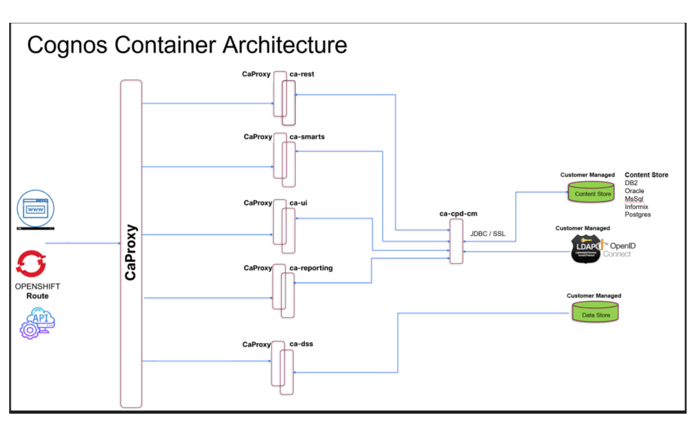
From a financial perspective, the value is immediate. Infrastructure costs can drop dramatically because you're no longer provisioning for worst-case scenarios. With Certified Containers, you provision for typical load and scale dynamically. Kubernetes can launch additional capacity within seconds and release it just as quickly. You pay for what you use, not for what you anticipate.
Availability on the AWS Marketplace (with Azure and Google coming soon) enables organizations to apply committed cloud spend toward Cognos licenses, turning a compliance requirement into strategic value.
What is more, operational agility improves dramatically. Disaster recovery can shift from “hours to restore” to “200 seconds to redeploy.” Fixed pack updates move toward zero-downtime deployments. Multi-cloud strategies become practical instead of theoretical.
The key architectural evolution underway is the decomposition of Content Manager into independent services, starting with authentication (CAM) as a separate, scalable service.
Why does this matter? Today, Content Manager serves as the monolithic heart of Cognos, handling authentication, output management, deployments, and content maintenance. Its centralized role also makes it a single point of scale. When Content Manager requires more resources, the entire application scales with it.
As CAM becomes an independent service (rolling out through 2026), authentication workloads will scale independently from other operations. Need to handle 10,000 concurrent logins? You can choose to scale the authentication without impacting output management or maintenance tasks. If you run content maintenance jobs monthly, keep those services idle until needed. Kubernetes can start them automatically while preserving compute resources for user-facing activities.
The goal is a minimum baseline of running services with dynamic scaling applied only where required. This is modern container architecture that directly optimizes your compute costs every single month.
This deployment option is offered as a trade-up license, granting dual entitlement. You can continue operating your traditional deployment while testing, validating, and transitioning to containers on your timeline. There is no forced march to containers, but the option is there when your infrastructure strategy aligns.
For deployment engineers: You gain modern DevOps workflows, automated deployment configurations, seamless integration with existing monitoring tools (Prometheus, Grafana, Datadog, IBM Instana), and the ability to deploy updates in minutes rather than hours.
For executives: You gain variable cost structures instead of fixed infrastructure, faster time-to-value for new deployments, improved disaster recovery posture, and the ability to strategically leverage committed cloud spend.
These insights are drawn from an IBM Cognos Analytics partner webinar presented by Greg McDonald. The session covered architectural details, deployment strategies, and roadmap information for Certified Containers.